
Calhoun Probation and Parole Differences
The South Carolina Department of Probation, Parole and Pardon Services, commonly called DPPPS, supervises several kinds of community cases. Probation is a sentence imposed by a court. It may allow a person to remain in the community under stated terms. Parole is a conditional release from a prison term approved under the law that applies to that sentence. Community supervision is a broader label that may appear when someone has left SCDC but still reports to DPPPS.
| Status | What it means | Best confirming record |
|---|---|---|
| Probation | Court-ordered community supervision | Calhoun court disposition and DPPPS record |
| Parole | Conditional release from state prison | Board result, SCDC release record, and DPPPS status |
| Community supervision | An SCDC release type with continuing oversight | SCDC Released Inmate Search and DPPPS |
| Discharge | Formal end of the applicable supervision term | DPPPS or court record, depending on the case |
Search Calhoun Supervision Records
The official DPPPS offender search accepts several combinations: first and last name; SID; first name and year of birth; last name and year; or county combined with SID, first name, or last name. Its information reflects the previous day. That timing matters when a release or change has just occurred.
- Choose the strongest identifiers available. A SID is better than a name alone.
- Search statewide first if the supervising county is uncertain, then use Calhoun as a filter where appropriate.
- Compare the name, year of birth, SID, county, and displayed status.
- Record the date searched because the dataset is not same-moment information.
- Confirm the match with the Calhoun DPPPS office when the result will guide a court or records process.
An absence is inconclusive. It can reflect spelling, timing, discharge, supervision in another county, or a case category outside the public results. The ordinary SCDC inmate search also excludes people solely under parole, probation, or other community supervision. Checking only SCDC can therefore miss the relevant state record.
The official offender-search screen shows how DPPPS asks users to narrow a supervision lookup. Open the DPPPS search at its source.
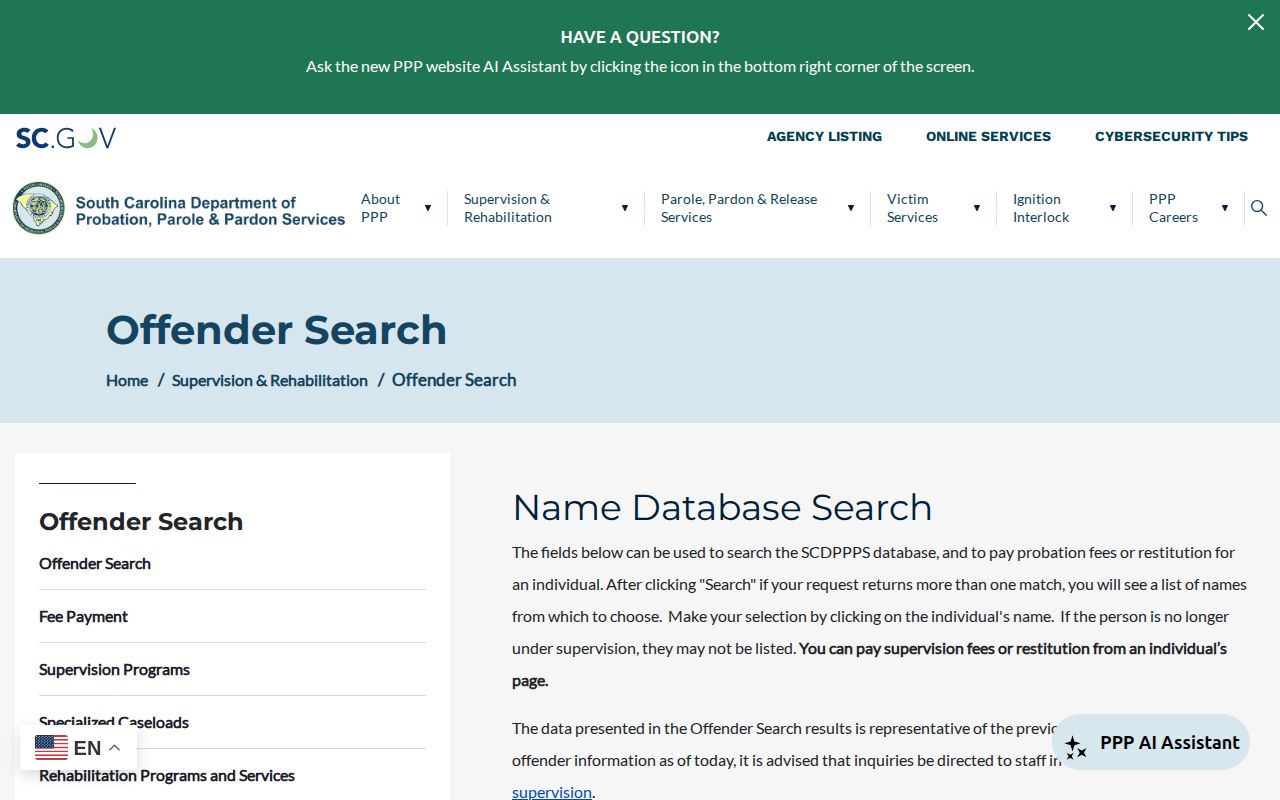
Use the form as a status lead, then contact the agency when identity or timing remains uncertain.
Calhoun County Supervision Office
The DPPPS Calhoun County office page identifies the local office responsible for supervision questions. It lists Agent in Charge Charles Webber, 120 Mill Street, St. Matthews, with mailing address PO Box 44, St. Matthews. The main number is 803-874-2537, the alternate number is 803-874-2401, and fax is 803-874-4575. Confirm current office details before traveling because directory entries can change.
Calhoun County DPPPS
Physical: 120 Mill Street, St. Matthews, SC
Mail: PO Box 44, St. Matthews, SC
Phone: 803-874-2537
Alternate: 803-874-2401
Fax: 803-874-4575
The directory also displays changing jurisdictional counts for probation, parole, community supervision, supervised reentry, Jessie’s Law tracking, and supervised furlough. Those figures are not Calhoun release totals. If quoted elsewhere, they require a retrieval date. For a person-specific question, provide a SID or SCDC number when known, along with the full name and year of birth.
Calhoun Release and Supervision Timing
A released state prisoner can disappear from the ordinary SCDC public search at the point when DPPPS verification becomes most useful. The separate SCDC Released Inmate Search can show a Release Date and Release Type. A value such as community supervision confirms departure from SCDC custody while also signaling continued oversight. It does not mean every legal obligation ended.
The DPPPS hearing and result page is a different record. Person-specific schedules are generally finalized about 30 days before a hearing. Dates and results can be delayed or rescheduled. A granted result is a board decision, not the exact time a person left an institution. Confirm physical release through the SCDC released search or SCDC records, then confirm ongoing supervision through DPPPS.
This sequence is distinctive in Calhoun County because state incarceration may occur at an SCDC institution elsewhere. The local regional detention center cannot certify an SCDC sentence calculation or a later parole discharge. The sentencing entry in the Calhoun Public Index helps connect the state record to the correct court case.
Calhoun Absconder Record Limits
DPPPS publishes a selective Most Wanted page and a tip line at 888-761-6175. It is not a complete supervision roster or a general warrant search. An at-large label describes an alleged supervision issue requiring official confirmation. It is not a new conviction. Never try to approach or detain a listed person. Call 911 for an immediate emergency.
An absconder is a person alleged to have stopped complying with required supervision contacts. A violation can lead to a warrant, hearing, modification, or revocation process, but the public page does not establish the final outcome. Use the exact DPPPS wording and date. If a name is absent, contact the Calhoun office rather than treating the missing result as proof that supervision ended.
VINE can provide custody or supervision-change notifications when the relevant agency feed supports them. It is not the underlying warrant or discharge record. The VINELink Inmate Search explains registration and the need to register again after some transfers.
Calhoun Rehabilitation Service Channels
DPPPS maintains official rehabilitation program navigation and a community-provider directory. The agency describes intervention, mental-health support, substance-use education, and specialized services for supervised people. Rehabilitative Services can be reached at 803-935-5101 or RehabilitativeServices@ppp.sc.gov. Provider coordination is available at 803-734-8731 or Service.Providers@ppp.sc.gov.
These contacts serve reentry and compliance needs. They do not confirm release by themselves. A family member reconnecting with someone should first determine whether the person left the Orangeburg detention center, SCDC, or federal custody. Then use the agency that owns that event. This prevents a service referral from being mistaken for a custody record.
Confirm Calhoun Supervision Discharge
Supervision ends through an official discharge, expiration, court act, or other process allowed by the governing sentence. An old date on a web result is not enough. Ask DPPPS to confirm the current status and obtain the relevant discharge record when the exact end matters. For probation, compare the answer with the Calhoun court docket. For parole or community supervision after SCDC, compare DPPPS with the SCDC release record.
If sources conflict, preserve each agency’s role and retrieval date. The court controls its order. SCDC controls institutional release and sentence records. DPPPS controls community supervision. The Orangeburg-operated detention center controls a local jail exit. The full Calhoun County released inmate search provides the county, state, and federal decision path.
Public Record Search
Sponsored Results
Trace Calhoun Post-Release Records
A complete supervision check starts with the custody event that came before DPPPS. For someone held on a Calhoun charge, ask the Orangeburg County Detention Center whether the person left for the community or transferred to SCDC. The event-specific release FAQ lists 803-531-4658. A transfer record means the regional jail’s custody ended, but it does not place the person on parole or probation. If SCDC received the person, the ordinary SCDC search may show current state custody as of the prior midnight.
After state release, use the separate SCDC Released Inmate Search. Search a defensible date range and compare SCDC ID, SID, Release Date, Release Type, Detainer, and County. The search’s County field is not automatically the county of arrest or conviction. A detainer can point to another custodian. A community-supervision release type directs the next check to DPPPS. Link the SCDC number back to the sentencing docket rather than merging institutional discharge and court disposition into one event.
If public tools do not settle the sequence, call SCDC Inmate Records at 803-896-8531. A focused request to FOIA@doc.sc.gov can seek the commitment, release or discharge record, release type, and sentence-calculation summary. Give the SCDC ID or SID and relevant dates. DPPPS then controls the current supervision answer, while the court controls any later order.
Interpret Calhoun Parole Results
The DPPPS hearing search accepts first and last name, SCDC number, name with hearing month, or a month alone. Its schedule is more useful than a general calendar for one person because cases are posted close to the event and may move. Record the exact outcome language. Granted means the Board approved parole subject to conditions and processing. Denied means parole was not approved at that hearing. Deferred, continued, rescinded, waived, or rescheduled should not be rewritten as denial.
Eligibility is sentence-specific. Title 24, Chapter 21 contains different rules based on offense, sentence date, mandatory minimums, and classification. Defined no-parole offenses follow separate limits. Do not estimate a first hearing date from sentence length alone. A granted result still requires an SCDC released record to confirm departure and a DPPPS record to confirm the supervision that followed.