
Federal BOP Release Coverage
The BOP Inmate Locator searches federal prisoners by register number or by name. Number search accepts BOP register, DCDC, FBI, or INS identifiers. Name results can display register number, current age, race, sex, release date, and location. A number is usually the most precise route because common names can return several people.
BOP historical coverage generally reaches federal inmates incarcerated from 1982 to the present. That makes the system more durable than a local current-custody roster and more useful after release. Older federal prison records may require the National Archives. Coverage does not make BOP a Calhoun County release list. It applies only when federal BOP custody actually occurred.
A result marked “RELEASED” means the person is no longer in BOP custody. It does not rule out state custody, immigration custody, a local hold, or federal supervised release. “UNKNOWN” means the confinement term has not been determined. A future date is a projection, and BOP warns that First Step Act recalculation can change dates. Keep each label in its original scope.
Search a Federal Release
- Establish that the person entered BOP custody rather than only USMS or local detention.
- Search by BOP register number when available.
- If searching by name, use the full name and compare age, race, and sex.
- Read the location and date together.
- Record the lookup date because federal data may lag.
- Compare the BOP identifier with the federal court docket.
- Contact BOP or request the underlying record when exact legal status matters.
The official locator screen provides the national search route. 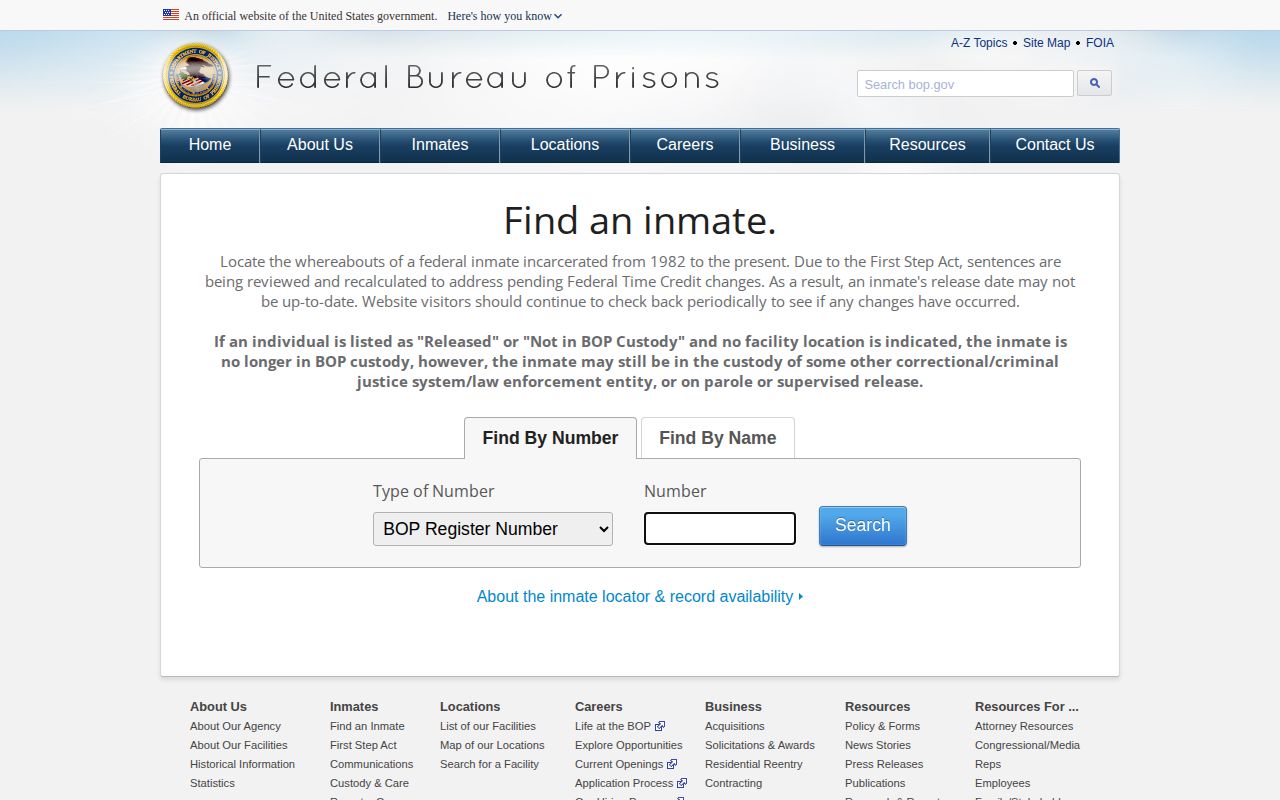 A displayed release date is evidence about BOP custody, but the federal docket and any supervision record provide separate context.
Do not force a federal result to explain a county event. A person can leave the Orangeburg County Detention Center for USMS transport and not appear immediately in BOP. Another person may complete a BOP term but enter state custody. Start with the transfer destination and follow the custody chain one agency at a time.
Calhoun Federal Transfer Checks
For a Calhoun arrest, call the Orangeburg County Detention Center at 803-531-4658 and ask whether the person left for the community or was transferred. Request the destination or receiving agency as recorded. The official release-information FAQ supplies that local contact. If staff reports USMS, ICE, or another federal authority, the event is a local jail exit but not proof of freedom.
Next review the Calhoun Public Index for the state case and the appropriate federal docket for federal proceedings. A state dismissal or bond order does not dispose of a federal case. Similarly, a federal release does not erase a separate state hold. Match case and custody records using identifiers and dates.
The Calhoun County Sheriff's Office can provide agency-held arrest or incident material through its records route, but it does not operate a separate jail verified by this research. Orangeburg controls the local physical custody record. BOP controls a later federal prison record. Keeping those owners distinct prevents a transfer from being misstated as a community release.
USMS Has No Release Archive
The United States Marshals Service often handles federal pretrial custody and transport. It does not provide an equivalent public historical release locator. A person held for USMS can remain in a local contract facility, move among facilities, enter BOP after sentencing, or leave under a federal court order. A failed BOP name search does not settle which occurred.
Use the holding facility, the federal court docket, and BOP if the person was designated to serve a federal sentence. Ask the local detention record for the receiving agency and transfer date. Then ask the receiving authority for the next event. A USMS transfer is a change of custodian. It is not a BOP release, and it is not itself proof of community release.
If the federal court ordered release, the docket can document the authority and conditions. It may not show the precise facility exit time. The holding facility owns that administrative event. As with Calhoun court records, reconcile the order with the custody sheet rather than treating one source as a substitute for the other.
ICE Release Locator Window
ICE's Online Detainee Locator System accepts an exact nine-digit A-number, padded with leading zeroes when needed, plus country of birth. It also accepts exact first and last name, country of birth, and optional date of birth. People under eighteen are excluded from the public locator.
ICE attorney resources state that the locator includes people currently detained and those released from ICE custody during the preceding 60 days. That is a short post-release window, not a durable archive. Save the lookup date. After the window closes, use ICE records or legal channels and the relevant immigration or federal court record. Do not infer immigration status from a missing result.
The ICE Detention Reporting and Information Line is 888-351-4024, Monday through Friday, 8:00 a.m. to 8:00 p.m. Eastern, for basic case help. No official Calhoun or Orangeburg source reviewed established an ICE detention contract at the Orangeburg facility. If a local release sheet states “to ICE,” use the destination as a lead and confirm with ICE rather than inventing a local program relationship.
Older Federal Prison Records
For federal confinement before the BOP locator's general 1982 coverage, the National Archives is the official fallback. Prepare the person's full name, date of birth or approximate age, race, and approximate incarceration dates. Include a federal register number or institution if known. A narrow, well-identified inquiry reduces same-name risk.
Archives research can establish an older federal prison episode. It still does not confirm release from the Orangeburg County Detention Center unless that local custody led into the documented federal matter. Compare the archived federal information with the local booking/release record and the court files. Historical records may use older names or identifiers, so preserve the source wording.
A same-name federal record is not enough. Compare stable identifiers and dates. Avoid republishing full birth dates or other unnecessary personal details. When two records appear to describe different people, stop and request clarification from the custodian rather than merging them.
Federal Release Record Requests
Begin with the agency that owns the event. BOP owns federal imprisonment and its release entry. USMS owns its transport or pretrial custody records. ICE owns immigration detention events. The federal court owns its orders and docket. Ask for the narrow record needed, identify the person and period, and request electronic delivery with a fee estimate.
For the preceding local stage, Calhoun County's FOIA channel covers Calhoun-held records, while Orangeburg County operates the detention center. Ask Orangeburg for the booking/release sheet and destination if the person left the local jail for a federal authority. Calhoun's fee schedule does not automatically apply to Orangeburg or a federal agency.
Protected law-enforcement, security, medical, victim, sealed, juvenile, and personal information may be withheld or redacted under the governing law. A redaction does not invalidate the remainder. Ask the agency to identify the legal basis and release segregable nonexempt portions. Keep the request focused on custody verification and the release or transfer event.
After a BOP Release
Federal supervised release is a court-ordered period in the community after imprisonment. It is not BOP institutional custody, and a BOP “RELEASED” result does not say that all court obligations ended. Review the federal judgment and docket, and use the appropriate federal probation office for authorized status questions. Do not treat supervised release as parole; the systems and legal sources differ.
A BOP release also does not foreclose a detainer. Another sovereign may assume custody. If location or status is unclear, follow the recorded destination, search the relevant state system, and contact the record owner. For South Carolina prison custody, use the current SCDC search. For an SCDC release, use its separate released search. For local detention, return to Orangeburg's record.
VINE may help with state and participating local custody but is not a federal BOP archive. The SLED registry is not a general release search. DPPPS covers South Carolina community supervision, not federal supervised release. The Calhoun County released inmate search decision path separates these systems and helps prevent a result from being assigned to the wrong custodian.
Federal Result Interpretation Rules
Use exact language. “Released” means no longer in BOP custody. “Transfer” means departure from one custodian for another. A projected date can change. A court order may precede physical processing. ICE's 60-day visibility is a locator limit, not proof that an older record never existed. USMS lacks a comparable public archive.
Always note what the channel covers, what it excludes, when it was checked, and which agency can confirm it. A photo is not release proof. A registry entry is not a custody record. A missing name is inconclusive. An affirmative record with matching identifiers, supported by the court or receiving agency, is the stronger basis for describing the event.