
Understanding Calhoun County Released Inmates
Calhoun County's local custody arrangement controls the first search step. The Sheriff makes arrests and holds related records, but Calhoun does not operate a separate local jail identified in the research. People detained on Calhoun matters are housed at the Orangeburg County Detention Center, historically called the Orangeburg-Calhoun Regional Detention Center. Orangeburg County now owns and operates that facility.
Leaving the detention center can mean bond, recognizance, time served, sentence completion, dismissal, acquittal, or another community-release authority. It can also mean transfer to SCDC, another jail, federal or immigration custody, a hospital, or treatment. The exit reason and destination carry more weight than disappearance from a roster.
A state-prison discharge is separate. SCDC controls the state sentence record and release type. Community supervision is separate again: DPPPS may supervise a person who appears in neither jail nor current SCDC custody. Federal release belongs to BOP and the federal docket.
How Calhoun County Custody Can End
Release language should be read literally. A court action, physical exit, and later supervision can occur at different times and appear in different records.
| Type | Meaning | Next official source |
|---|---|---|
| Bond or recognizance | Conditional pretrial return to the community; not a finding of innocence or guilt. | Court bond order plus detention release record. |
| Time served or sentence completion | Custody ends under a sentence or disposition after processing. | Court sentencing entry and jail or SCDC discharge record. |
| Dismissal or acquittal | The identified charge ends, though another hold can remain. | Calhoun court docket and detention confirmation. |
| Parole or community supervision | Institutional custody ends while DPPPS authority continues. | SCDC released result and DPPPS offender search. |
| Transfer or detainer | One facility's custody closes while another custodian takes over. | Sending facility's destination and receiving agency's locator. |
- Release
- An agency records the end of its custody, which may or may not mean freedom from every authority.
- Discharge
- Completion of the applicable custody or supervision obligation as officially recorded.
- Projected release
- An estimate subject to sentence rules, credits, forfeitures, holds, and court changes.
- Expungement
- A statutory process that can make qualifying arrest or booking material nonpublic, sealed, or destroyed.
What a Calhoun County Release Record Shows
A useful release record answers who, from where, when, and under what authority. No single public screen necessarily contains every field. The detention record establishes physical custody; the court establishes orders and dispositions; SCDC establishes state incarceration and discharge; DPPPS establishes supervision.
| Field | What it shows |
|---|---|
| Name, aliases, birth information | Identity, best paired with a number rather than used alone. |
| Booking, SCDC, SID, or case number | Connects the release to one custody episode and another official system. |
| Facility and booking date | Where and when custody began. |
| Release date and time | When the agency completed its custody exit. |
| Release type or authority | Bond, time served, dismissal, sentence completion, supervision, transfer, or detainer. |
| Destination | Whether custody ended in the community or continued under another agency. |
| Charge and court case | The legal matter tied to the booking, subject to later disposition and correction. |
A record may be redacted for juvenile, sealed, expunged, medical, victim, security, or protected personal information. An arrest, charge, or booking photograph is not proof of guilt.
Obtain Calhoun County Release Records
For a local custody episode, first call the detention release-status line at 803-531-4658. Provide a full name, date of birth or year, booking number if known, and approximate dates. Ask whether the person was released or transferred and request the recorded date, time, reason, and destination. If details cannot be given by phone, ask which office owns the booking/release sheet.
- Limit the request to one person and one custody episode.
- Give a booking or case number and a bounded date range.
- Ask for the booking/release sheet, release date and time, release authority, destination, receiving agency, and releasable booking photograph only if needed.
- Request electronic delivery and a fee estimate. Ask for segregable portions if some information is withheld.
- Keep the acknowledgment, estimate, production date, and source URL with the record.
The Calhoun County FOIA channel allows online and form-based requests and identifies certain recent confinement documents for in-person inspection. The Sheriff's FOIA route applies to Sheriff-held arrest and incident records; Orangeburg may be the custodian for the detention-created release sheet.
Calhoun's published fee schedule states $10 for records search, $0.35 per photocopy, $5 for a flash drive, and an hourly labor charge equal to the lowest-paid qualified employee, prorated, with deposits up to 25 percent. South Carolina FOIA generally uses a ten-business-day initial response for records under 24 months old and twenty business days for older records. The response can provide a production schedule rather than the records themselves.
South Carolina Law and Calhoun Release Records
South Carolina Freedom of Information Act, Title 30 Chapter 4, governs access subject to exemptions. It identifies documents showing people confined during the preceding three months among records available for inspection during normal business hours without requiring a written request, except juvenile and other protected material. This does not promise every release field or photo.
Section 17-1-40 governs qualifying expunged arrest and booking material. Once the legal process makes material nonpublic, sealed, or destroyed, absence should be respected rather than reconstructed through another source. Section 17-1-60 addresses specified paid-removal publication practices. It is not a blanket statement that every booking image is public forever.
Search for a Released Calhoun County Inmate
Start with custody type, not a broad name query. Calhoun local detention, SCDC, DPPPS, BOP, and ICE each have different coverage. Use two identifiers whenever possible and record the time each dynamic source was checked.
- For a Calhoun arrest, call the Orangeburg detention center and ask release versus transfer.
- Search the Calhoun Public Index by case number when available. Read bond, disposition, sentence, and later events rather than treating the initial charge as the result.
- Check VINE for the correct person and agency. Use it for status and notifications, then corroborate.
- If state custody is plausible, check current SCDC and the separate SCDC Released Inmate Search in the correct order.
- Search DPPPS when parole, probation, or community supervision is plausible. Search BOP only for federal custody and ICE only where immigration custody is supported.
- Request the source record when online results are missing, ambiguous, or need certification.
A person missing from a current roster may have transferred, encountered a data delay, been searched under different spelling, or have a sealed or expunged matter. Write “not found in the searched current-custody system as of [time]” until an affirmative record supports release.
Calhoun Court Records Can Explain a Jail Exit
The statewide public index must be set to Calhoun County for a Calhoun case. The direct Calhoun Public Index can show county, court type, case number, parties, charge, events, disposition, sentence, and financial entries. Cookies, JavaScript, and pop-up permission may be necessary. Name-only searches carry collision risk, so compare case number, charge, filing or arrest date, and party details.
The court layer depends on case level. Orangeburg's official information distinguishes General Sessions matters, handled with the Solicitor's Office, from Magistrate-level matters, where Magistrate Court and a Sheriff's advocate can provide status information. For Calhoun matters, verify which court owns the case before asking for a bond order, disposition, or sentencing sheet.
The Calhoun Clerk of Court maintains and dockets Circuit Court cases. The office is at 902 FR Huff Drive, St. Matthews, and its published hours are Monday through Friday, 9 a.m. to 5 p.m.; phone 803-874-3524. Copies are listed at $0.50 per page. A court order explains authority, but the detention record remains stronger for the exact physical exit.
Search SCDC Releases From Calhoun County
The ordinary SCDC inmate-search disclaimer is critical. The current system excludes people already released from SCDC, people sentenced to county detention facilities, and people solely under parole, probation, or community supervision. Its information is updated to the prior midnight. A current result can confirm state custody and show sentence or projected information, but it cannot prove local community release.
South Carolina also provides a separate Released Inmate Search. Enter release-date from and to values and choose Calhoun, code 09, only when that filter is appropriate; otherwise use all locations and verify identity. Results can include SCDC ID, SID, name, Release Date, Release Type, Detainer, County, and an undefined MSO field. “COMMUNITY SUPV” means institutional release with continuing supervision.
The official SCDC search form demonstrates the date-range and county workflow:
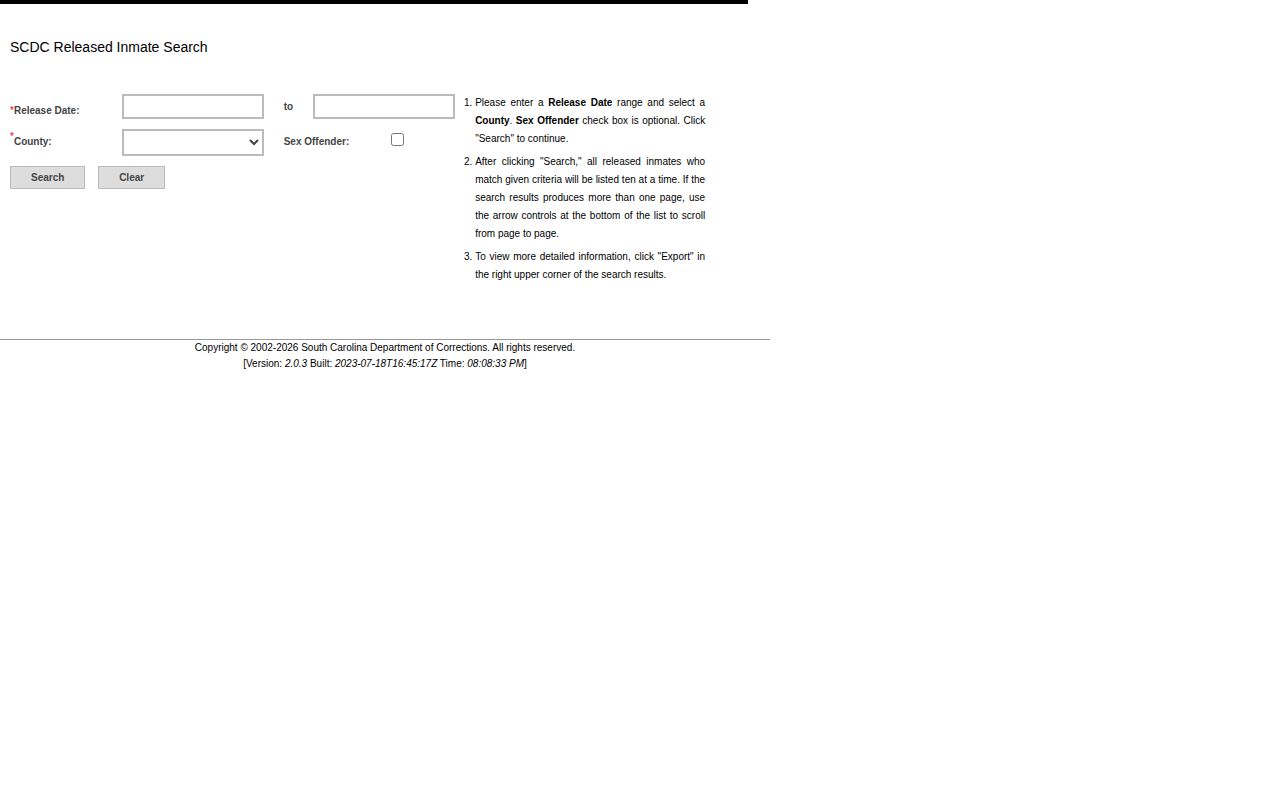
This search is the strongest online path for an SCDC discharge, but it does not cover a person released only from the Orangeburg detention center.
Why the Regional Jail Name Changed
The familiar Orangeburg-Calhoun Regional Detention Center name can obscure a governance change. An Orangeburg County procurement document states that the joint regional detention commission dissolved in 2012 and Orangeburg County became sole owner. Current sources therefore also use Orangeburg County Detention Center.
The historical name remains useful because older records may still use it. Orangeburg controls the detention release event, while the Calhoun Sheriff controls records created by that office. Route a request according to the record creator.
Recent Calhoun County Jail Release Searches
No official 24-hour or 72-hour local release feed, photo roster, or sheriff mobile app was found as of August 1, 2026. Those are search intents rather than government datasets. The Jail Releases: 24 Hours route emphasizes immediate detention confirmation and bond checks; Jail Releases: 72 Hours emphasizes multi-day docket review and recent-record inspection.
The official Orangeburg release FAQ supplies the release-specific phone channel:
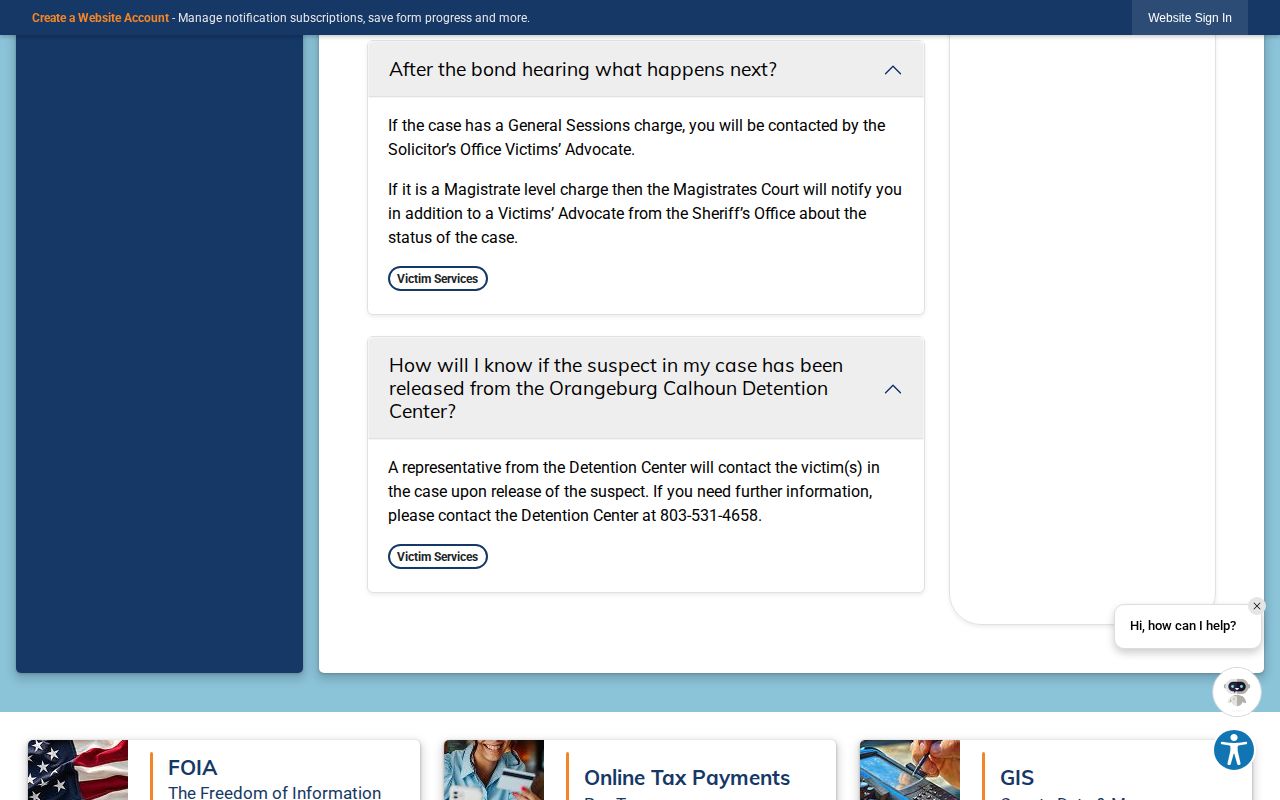
The FAQ supports a direct inquiry, not a public list. Ask for release versus transfer, then corroborate with the case record.
Which Ellis Avenue Office Handles a Release Question?
Official sources publish two adjacent Ellis Avenue addresses and several phone numbers. Current Orangeburg material identifies the detention center at 1534 Ellis Avenue, while Bond Court and the law complex use 1520 Ellis Avenue.
Call before traveling and state whether the purpose is a physical release record, detention status, or a court order. The release FAQ supports 803-531-4658; other current Orangeburg pages list 803-539-2091 and 803-531-4139 for their own routes. The county switchboard at 803-533-1000 can route a caller to Detention Center records.
Bond Court Timing Is Not a Release Schedule
Orangeburg County says Bond Court holds hearings twice daily. That fact can help explain why a same-day court event appears, but it cannot predict the exact detention exit. Bond is conditional pretrial authority, not a disposition. Other holds and administrative processing may prevent or delay community release.
Current official sources also identify two adjacent Ellis Avenue addresses. Orangeburg materials place the detention center at 1534 Ellis Avenue and Bond Court/law complex at 1520 Ellis Avenue. Call before traveling and state whether the need involves detention records or court. The release-specific 803-531-4658 number is the strongest first call, while other current Orangeburg pages publish 803-539-2091 and 803-531-4139 for different routing.
Probation and Parole After Calhoun Release
A person can be out of jail and absent from the current SCDC search while supervised by the South Carolina Department of Probation, Parole and Pardon Services. Its offender search accepts several combinations, including first plus last name, SID, name plus year of birth, or county plus identity fields. Data reflect the previous day, and absence can mean spelling, timing, another county, discharge, or a category outside the public search.
The Calhoun DPPPS office is at 120 Mill Street, St. Matthews, with phone 803-874-2537 and alternate 803-874-2401. Confirm ongoing supervision with the agency. A hearing result or parole grant is not the physical release timestamp. See Probation & Parole for the supervision workflow.
VINE, Federal, and Immigration Release Checks
South Carolina VINE provides agency-fed custody information and notifications by phone, email, SMS, and TTY. Search by name or offender number and compare identity. Phone registration uses a four-digit PIN; calls repeat for up to 48 hours or until the PIN is entered. Transfers can require re-registration. VINE cannot track adults already out on bond, and no result is not a certified release.
The BOP Inmate Locator generally covers federal records from 1982 onward and can show “Released,” a release date, and location. It proves only departure from BOP custody. A future date is projected and may change. For a recent ICE release, the Online Detainee Locator generally retains post-release visibility for 60 days. A local record saying “to ICE” is a transfer, not community release. The U.S. Marshals Service has no equivalent public historical release search.
Released Versus Still in Custody
Match the channel to the question and preserve each system's limits.
| Status question | Where to look | What confirms it |
|---|---|---|
| Recent Calhoun jail exit | Orangeburg detention center | Release date/time, reason, and destination. |
| Current state imprisonment | Ordinary SCDC search | Current location as of the system date. |
| Past state discharge | SCDC Released Inmate Search | Matched ID, release date, and release type. |
| Court authority | Calhoun Public Index or Clerk | Bond, disposition, or sentencing entry. |
| Community supervision | DPPPS offender search | Agency supervision record as of its data date. |
| Federal release | BOP locator and federal docket | BOP release label/date plus case context. |
Calhoun County Release Facilities and Agencies
Each agency owns a different part of the record. Use the facility page matching the actual custody system.
- Orangeburg County Detention Center / Orangeburg-Calhoun Regional Detention Center: confirms local physical release or transfer.
- Calhoun County Sheriff’s Office: holds Sheriff-originated arrest, incident, and FOIA records; it does not operate the regional jail.
- South Carolina Department of Corrections Institutions: controls state custody, sentence calculation, and discharge records.
- Federal Bureau of Prisons Institutions: controls federal incarceration and locator status.
When two official sources conflict, preserve both source dates and roles. Ask the detention center about local exit, SCDC about state discharge, DPPPS about supervision, the court about orders, and BOP or ICE about their own custody.
Verify Calhoun Release Identity and Correct Errors
Use at least two stable identifiers when possible: booking number, SCDC ID, SID, case number, birth year, or a tight date range. Avoid publishing a full birth date unnecessarily. If two records appear merged, stop and contact the custodian rather than choosing the most convenient match.
For a detention or Sheriff error, contact the office that created the record. For a court error, contact the Clerk. SCDC current-detail errors can be reported to its Ombudsman, while SCDC FOIA or Inmate Records can supply an official discharge record. Correction fixes inaccurate data; expungement is a separate statutory process for qualifying records.
A screenshot, notification, or photo is secondary evidence. Confirm the latest status through the record owner, and date-stamp every dynamic result. This disciplined approach protects both accuracy and the dignity of the person named.
Public Record Search
Sponsored Results